

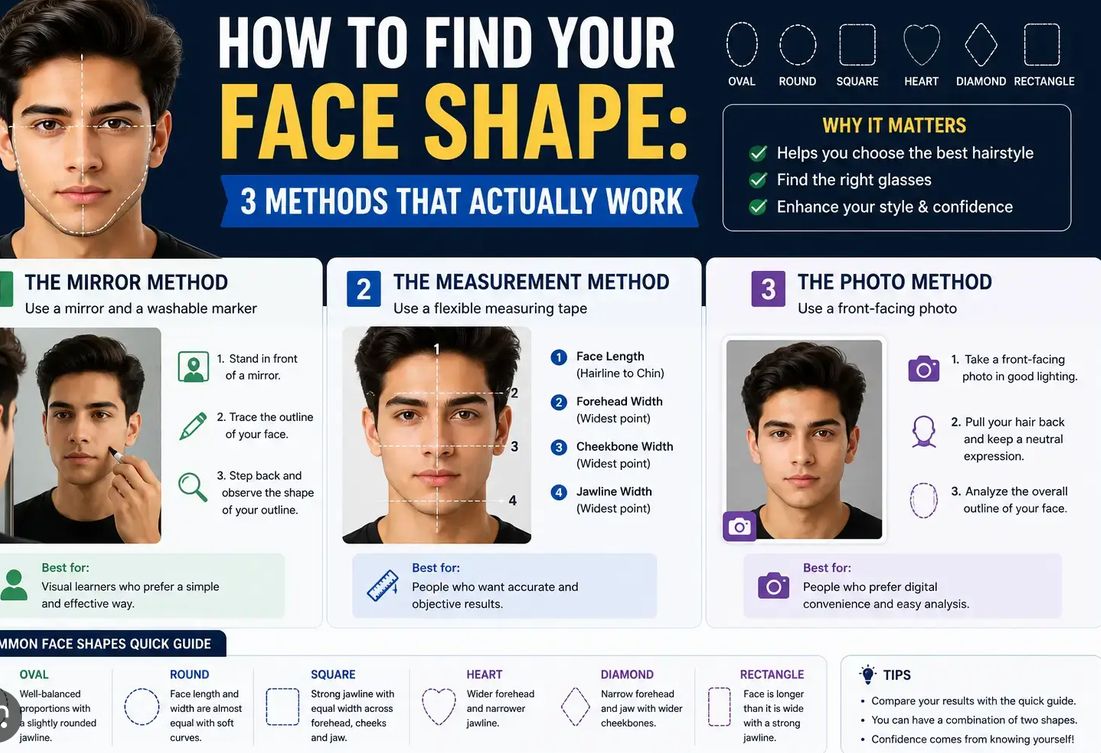
Knowing your face shape can make it easier to understand why certain hairstyles, glasses, beard styles, makeup techniques, or necklines look different from one person to another. But identifying a face shape is not always as simple as comparing your reflection with a picture on a generic face shape chart.
Real faces often sit between categories. Your face may have the length of an oval shape but a jawline that looks more square, or cheekbones that suggest a diamond shape while the overall proportions resemble an oval.
The good news is that you can determine your face shape using a few basic proportions, a mirror, a measuring tape, or a photo-based face shape detector.
What Is a Face Shape?
A face shape is a general description of the geometric proportions and contours of your face.
The most commonly discussed categories include:
- Oval
- Round
- Square
- Oblong
- Rectangle
- Heart
- Diamond
- Triangle
These labels are useful for styling and comparison, but they are not medical classifications. There is also no single worldwide standard that defines exactly where one face shape ends and another begins. Different guides can therefore classify the same person slightly differently.
The most useful approach is to look at several measurements together rather than relying on one visual feature.
What Determines Your Face Shape?
Three main characteristics are particularly useful when identifying facial shape:
1. Face Length Compared With Face Width
Start by comparing the vertical length of your face with its widest point.
A longer face tends to point toward categories such as oval, oblong, or rectangle. A face with length and width that are relatively close may be more consistent with round or square categories.
The exact boundary varies between classification systems, which is why borderline results are common.
2. Your Widest Facial Area
Next, determine which area appears widest:
- Forehead
- Cheekbones
- Jaw
If the cheekbones are clearly the widest area while both the forehead and jaw are narrower, the proportions may resemble a diamond shape.
If the forehead is noticeably wider and the chin narrows, a heart-shaped profile may be a closer match.
If the jaw is the widest region, the face may fall toward a triangle classification.
3. Jawline Contour
The jawline can help distinguish between shapes that otherwise have similar measurements.
For example, round and square faces can have relatively similar length-to-width proportions, but a square face generally has a more angular jaw while a round face tends to have a softer, curved contour.
Likewise, oblong and rectangle profiles can both be relatively long, but the jaw contour can help separate them.
How to Measure Your Face at Home
If you want to determine your face shape manually, you only need a soft measuring tape and a mirror. A piece of string can also work if you measure the string afterward with a ruler.
Pull your hair away from your face before measuring so that your hairline and facial edges are visible.
You generally need four measurements:
Face Length
Measure from the center of your hairline straight down to the lowest point of your chin.
Keep your head level while measuring. Looking upward or downward can change the apparent length.
Forehead Width
Measure across the widest visible part of your forehead.
Keep the measurement straight rather than following the curve of your head.
Cheekbone Width
Find the widest point across your cheekbones and measure straight across.
This is an important measurement because cheekbone width is commonly used as the reference point when comparing the proportions of different areas of the face.
Jaw Width
Measure the straight-line distance between the two corners of your jaw.
Be careful with this measurement because different face shape guides use different definitions of jaw width. Measuring from the ear to the chin and doubling the result is not the same as measuring straight across between the jaw corners.
Using the wrong method can significantly change the final classification.
Use a Face Shape Detector From a Photo
Manual measurements are useful, but they can be difficult to take consistently. A photo-based tool can make the process much faster.
The Face Shape Detector can analyze a front-facing photograph or use your device’s camera to estimate facial proportions. It compares the measurements against eight face shape profiles and shows the closest and secondary matches rather than simply presenting a single unexplained label.
The detector also provides information about the measurements behind the result, helping you understand why a particular shape was selected.
For better results, use a clear photograph with:
- One face in the image
- The camera approximately at eye level
- A neutral facial expression
- Your forehead, cheekbones, jaw, and chin visible
- Soft, even lighting
- Your hair pulled away from the sides of your face
Very close selfies can introduce lens distortion, while tilted heads, strong filters, poor lighting, or partially covered facial features can affect measurements.
Can You Calculate Your Face Shape Without a Photo?
Yes. A manual calculator can be useful when you prefer not to use a photograph.
The Face Shape Calculator uses four measurements—face length, forehead width, cheekbone width, and jaw width—and compares their proportions against eight face shape profiles.
One advantage of manual measurement is that you can choose exactly where your hairline and facial measurement points are located. It also avoids camera-related issues such as lens distortion.
Use the same unit for every measurement. Centimeters and inches both work; the important thing is not to mix units.
Understanding the Eight Main Face Shapes
Oval Face
An oval face is generally longer than it is wide, with cheekbones that lead the overall proportions and a relatively gentle jaw taper.
Because the proportions are balanced, oval faces are frequently used as a reference point in styling discussions.
Round Face
A round face tends to have relatively similar length and width, with a softer jaw contour.
The cheeks can appear prominent, while the overall outline lacks the stronger corners associated with a square face.
Square Face
A square face tends to have relatively compact proportions and a more angular jaw.
The forehead, cheekbones, and jaw can appear comparatively close in width.
Oblong Face
An oblong face is noticeably longer than it is wide, while the facial widths remain relatively consistent.
The jaw is generally softer than the stronger angular jaw associated with a rectangle classification.
Rectangle Face
A rectangle face combines a longer facial proportion with a stronger, more angular jaw.
It can therefore resemble a combination of oblong length and square-like jaw structure.
Heart Face
A heart-shaped face typically has a wider upper face and a narrower lower face, often ending in a more tapered chin.
The forehead may be the widest region.
Diamond Face
A diamond-shaped face tends to have prominent cheekbones, with the forehead and jaw appearing narrower.
The chin can also have a noticeable taper.
Triangle Face
A triangle-shaped face tends to be wider around the jaw than around the upper face.
The jaw therefore becomes the dominant width when compared with the forehead and cheekbones.
Why Different Face Shape Tests Can Give Different Answers
It is normal for two face shape tests to produce slightly different results.
One reason is that face shape categories are not universally standardized. Different tools can use different thresholds for length, width, and jaw proportions.
Measurement technique also matters. For example, changing the location of the cheekbone measurement by even a small amount can alter the resulting ratio.
Photography introduces additional variables. Camera distance, lens characteristics, head rotation, lighting, facial expression, and hair placement can all influence the visible outline of a face.
This is why a good face shape analysis should be treated as a geometric estimate rather than an absolute identity.
What If Your Result Is Between Two Face Shapes?
A borderline result does not necessarily mean that the test failed.
Many people naturally have mixed characteristics. Someone might have an oval-like length-to-width ratio but a jaw that is more characteristic of a square face.
Instead of forcing yourself into one category, consider the top two results and look at which measurements are creating the difference.
This can actually be more useful for styling because you can consider recommendations for both characteristics.
Does Face Shape Determine Attractiveness?
No.
Face shape is simply one way of describing facial geometry. It should not be treated as a score for attractiveness or as a measure of someone’s appearance.
Facial appearance is influenced by many factors, including symmetry, individual features, expression, hairstyle, lighting, and personal preferences.
A face shape detector is best used as a practical styling and self-understanding tool—not as a judgment of whether a face is attractive.
How to Get a More Reliable Result
For the most consistent result, avoid relying on a single poor-quality selfie or rushed measurement.
Instead:
- Pull your hair away from your face.
- Keep your head straight and your chin level.
- Use even lighting.
- Avoid strong filters.
- Keep your expression relaxed.
- Use a camera distance that does not require an extremely close selfie.
- If measuring manually, use the same unit throughout.
- Repeat the measurement if a result seems unusual.
- Compare the primary result with the secondary result when available.
If a photo-based result and a manual result disagree, check your measurement points and photo conditions before assuming that one tool is necessarily wrong.
The Best Way to Think About Your Face Shape
The goal of identifying your face shape is not to put yourself into a rigid category.
Think of face shapes as useful geometric descriptions. They can help you understand proportions and make more informed decisions about hairstyles, glasses, facial hair, makeup, and other styling choices.
A good analysis should also explain why a face was classified a certain way.
Whether you use a photo detector, camera analysis, or a measuring tape, the most useful result is one that lets you see the proportions behind the conclusion rather than giving you a label without any explanation.
If you want a quick photo-based result, you can try the free Face Shape Detector. If you prefer to take your own measurements, the Face Shape Calculator provides a measurement-based alternative.
