

Choosing a new mattress can feel surprisingly difficult. There are countless brands, materials, firmness levels, and designs available, and two options that often appear at the top of the list are memory foam and hybrid mattresses. Both can provide excellent comfort, but they feel very different when you lie down and have different strengths depending on how you sleep.
A mattress is also a long-term purchase. The wrong choice can affect your sleep every night, while the right one can make your bedroom feel noticeably more comfortable. That is why it is useful to understand how memory foam and hybrid mattresses are constructed, how they respond to body weight, how they handle heat, and which type may suit different sleeping positions.
This detailed comparison looks at the important differences between memory foam vs hybrid mattresses without focusing on one particular brand. By the end, you should have a clearer idea of what each mattress type offers and what to consider before buying.
What Is a Memory Foam Mattress?
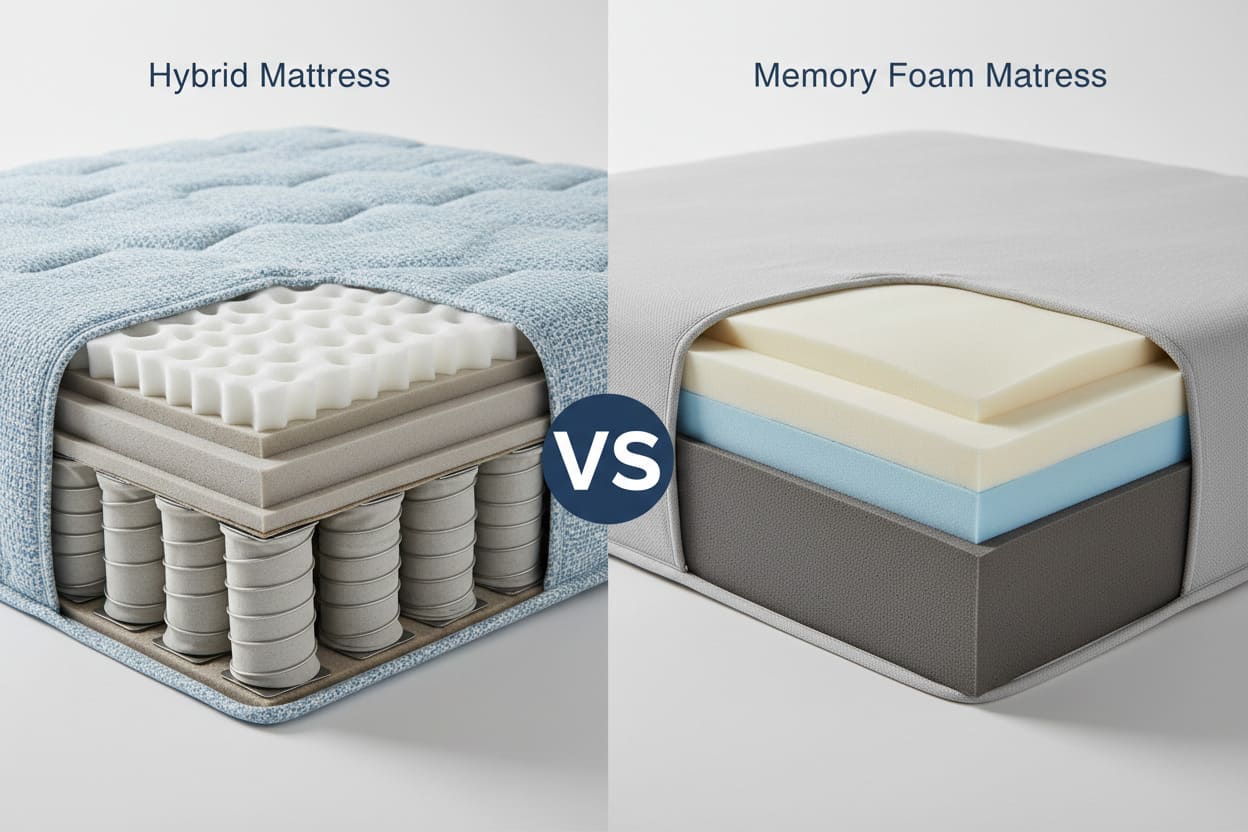
Memory foam is a type of pressure-relieving foam that was originally developed for specialized applications before becoming popular in household mattresses. Modern memory foam mattresses usually contain several foam layers, with a softer comfort layer placed above one or more supportive foam layers.
The main characteristic of memory foam is its ability to respond to body weight. When you lie on it, the foam gradually compresses around areas such as the shoulders, hips, and lower back. When you move away, the material slowly returns toward its original shape.
This creates the familiar feeling of being gently surrounded by the mattress rather than simply lying on top of it.
Memory foam mattresses can have different firmness levels. Some are plush and soft, while others are designed to provide a much firmer sleeping surface. The quality and density of the foam can also vary considerably between models.
What Is a Hybrid Mattress?
A hybrid mattress combines different materials in a single design. Most modern hybrids use individually wrapped coils as the main support system, combined with one or more comfort layers made from materials such as memory foam, latex, or other types of foam.
The purpose of a hybrid design is to combine the responsive support of an innerspring system with the cushioning of modern comfort materials.
Because the support core contains coils, hybrid mattresses generally have a more responsive feel than all-foam mattresses. They can make it easier to change positions during the night and can provide stronger edge support, depending on the construction.
Hybrid mattresses are available in a wide range of firmness levels, so the word “hybrid” does not automatically mean a mattress will be firm or soft. The specific materials and construction matter.
Memory Foam vs Hybrid: The Main Difference
The simplest way to understand the difference is to think about how each mattress responds to movement.
Memory foam generally provides a slower, more contouring response. It allows your body to sink into the material and can create a cushioned, enclosed sensation.
A hybrid mattress usually has a quicker response because the coil system pushes back against your body. You may feel more like you are resting on top of the mattress rather than sinking deeply into it.
Neither feel is automatically better for everyone. Personal preference, sleeping position, body weight, temperature preferences, and movement habits all play a role.
Comfort and Pressure Relief
Comfort is one of the most important factors when choosing a mattress, but comfort is highly personal.
Memory foam is well known for its contouring ability. The material can distribute pressure across a larger area by allowing heavier parts of the body to sink into the surface. Many people enjoy this sensation because it creates a soft, cushioned feeling around the body.
This can be particularly appealing to people who prefer a mattress that feels like it is hugging them.
Hybrid mattresses can also provide excellent pressure relief, especially when they contain a substantial comfort layer. The foam or other cushioning material works together with the coil system to support the body.
The main difference is that the coils provide a more responsive base beneath the comfort layers. As a result, the mattress may feel less enveloping than traditional memory foam.
If you enjoy a deep, slow-sinking sensation, memory foam may feel more natural. If you want cushioning but also prefer a more responsive surface, a hybrid may be worth considering.
Support and Spinal Alignment
A mattress should support the body while allowing the spine to remain in a comfortable and reasonably neutral position.
Memory foam can provide good support when its firmness and construction are appropriate for the sleeper. Because the material contours around the body, it can fill spaces around areas such as the lower back and provide a consistent surface.
However, extremely soft foam may allow some sleepers to sink more deeply than they prefer. The appropriate firmness depends on body shape, sleeping position, and personal comfort.
Hybrid mattresses use coils as their primary support structure. Individually wrapped coils can respond to different areas of the body and provide a supportive foundation underneath the comfort layers.
For people who prefer a stronger push-back sensation, a hybrid may feel more supportive. Again, the exact design matters more than the mattress category alone.
Which Mattress Is Better for Side Sleepers?
Side sleepers often place greater pressure on the shoulders and hips because those areas make more direct contact with the mattress.
Memory foam can be attractive for side sleepers because it molds around these pressure points. A suitable memory foam mattress can allow the shoulder and hip to sink enough to create a more comfortable sleeping position.
Hybrid mattresses can also work very well for side sleepers when they have adequate cushioning on top. A hybrid with a relatively soft comfort layer can combine pressure relief with the responsive support of coils.
The key is not simply choosing memory foam or hybrid. Side sleepers should pay attention to firmness, comfort-layer thickness, and how the mattress responds to their individual body shape.
Which Mattress Is Better for Back Sleepers?
Back sleepers generally need a balance between cushioning and support.
A mattress that is too soft may allow the hips to sink excessively, while one that is too firm may create uncomfortable pressure in other areas.
Memory foam can provide a smooth, contouring feel that some back sleepers appreciate. It can cushion the body while supporting the lower back area.
Hybrid mattresses can offer a more responsive support structure, which some back sleepers prefer. The coil system can provide a stable foundation while the upper layers provide cushioning.
For back sleepers, the right firmness level is usually more important than whether the mattress is technically foam or hybrid.
Which Mattress Is Better for Stomach Sleepers?
Stomach sleepers often need to pay close attention to firmness and support because the midsection can sink too deeply into a soft mattress.
A firmer mattress may help prevent excessive sinking. Some stomach sleepers therefore prefer a supportive hybrid mattress, particularly when it has a firmer comfort layer and a strong coil system.
Memory foam is not necessarily unsuitable for stomach sleepers, but very soft all-foam designs may not provide the feel they prefer.
If you sleep primarily on your stomach, look for a mattress that keeps your body adequately supported rather than focusing only on surface softness.
Temperature and Sleeping Hot
Temperature is one of the biggest differences people notice between mattress designs.
Traditional memory foam has a reputation for retaining more body heat because the sleeper’s body can sink into the material, reducing airflow around the body. Modern memory foam mattresses may use breathable covers, open-cell foams, cooling materials, or ventilation features to improve temperature management.
Hybrid mattresses can have an advantage in airflow because their coil systems create open spaces inside the support core. Air can move through these spaces more freely than through a solid block of foam.
However, a hybrid mattress can still sleep warm if it has thick layers of dense foam or other heat-retaining materials.
If you regularly wake up feeling hot, consider the entire construction of the mattress rather than assuming that every hybrid will sleep cool or every memory foam mattress will sleep hot.
Motion Isolation
Motion isolation is especially important for couples.
When one person turns over, gets out of bed, or changes position, a mattress with good motion isolation can reduce how much movement travels across the surface.
Memory foam generally performs well in this area because the foam absorbs movement. If one person moves on one side, the disturbance may be less noticeable on the other side.
Hybrid mattresses can also provide good motion isolation, particularly when they use individually wrapped coils and substantial comfort layers. However, some hybrids can feel more responsive, which means movement may be easier to notice.
For couples with different sleeping schedules, motion isolation can be an important factor to investigate.
Ease of Movement
A mattress that absorbs movement can be comfortable, but there is another side to that feature.
Some people do not enjoy the feeling of sinking into memory foam. They may find it slightly harder to change sleeping positions because the foam takes time to respond.
Hybrid mattresses generally offer a quicker response. The coils push back as you move, making the surface feel more energetic.
This can be helpful for people who move frequently during the night or simply prefer a mattress that does not feel deeply enveloping.
Edge Support
Edge support refers to how stable the mattress feels when you sit or sleep close to its edge.
Hybrid mattresses often have an advantage because the coil system can provide a strong structural foundation. Some models also include reinforced perimeter coils or additional edge-support materials.
All-foam mattresses can have good edge support too, but the experience depends heavily on the foam density and construction.
Strong edge support can be useful for couples who need to use the full width of the bed. It can also make getting in and out of bed feel more stable.
Durability and Longevity
The lifespan of a mattress depends on its materials, construction, quality, usage, body weight, maintenance, and other factors.
A well-made memory foam mattress can last for many years, but lower-quality foam may lose its shape or develop impressions sooner.
Hybrid mattresses contain more mechanical components because of their coil systems. High-quality coils can provide durable support, while the comfort foam on top will still influence how long the mattress feels comfortable.
Instead of judging durability solely by mattress type, look at material specifications, warranty terms, construction details, and the reputation of the manufacturer.
Noise
Noise may not be the first thing shoppers consider, but it can matter.
Memory foam mattresses are generally very quiet because they do not contain metal springs.
Hybrid mattresses contain coils, so some designs may produce more sound as the mattress ages or as the components move. Modern individually wrapped coils are generally designed to reduce noise compared with older spring systems.
If you are particularly sensitive to sound, an all-foam mattress may provide a simpler construction.
Weight and Moving the Mattress
Memory foam mattresses can be heavy, especially when made from multiple dense foam layers. Hybrid mattresses can also be quite heavy because they combine foam with a coil system.
Neither category should automatically be considered lightweight.
If you move frequently, live in a building with difficult stairs, or expect to move the mattress yourself, check the actual weight listed by the manufacturer before purchasing.
A mattress that looks manageable in a showroom can feel very different when you have to carry it up a staircase.
Firmness Options
Both memory foam and hybrid mattresses are available in different firmness levels.
Memory foam can range from very soft to very firm. The amount and density of the comfort layers have a major effect on the final feel.
Hybrids also vary widely. Some are designed to feel plush, while others have a firmer surface intended for sleepers who prefer stronger support.
This is why comparing mattress categories alone is not enough. Two hybrid mattresses can feel completely different, just as two memory foam mattresses can have very different comfort levels.
Memory Foam vs Hybrid for Couples
Couples often have different preferences. One person may prefer a soft mattress while the other wants something firmer.
A memory foam mattress can be useful when motion isolation is a major priority. Its ability to absorb movement may reduce disturbances when one partner changes position.
A hybrid can be appealing when both sleepers want a balance between cushioning and responsiveness. The coil system can also provide a more supportive feel across the sleeping surface.
Couples should consider motion isolation, edge support, firmness, sleeping positions, and individual body types rather than choosing based on mattress category alone.
Which Mattress Is Easier to Get Used To?
Your previous mattress can influence how quickly you adapt to a new one.
Someone moving from a traditional spring mattress to memory foam may notice the slower response immediately. The sinking sensation can feel unusual during the first few nights.
Likewise, someone who has been sleeping on soft memory foam may initially find a responsive hybrid mattress firmer or more active.
Many mattresses require an adjustment period. This is one reason sleep trials can be valuable when purchasing online.
Price Differences
Prices vary dramatically within both categories.
You can find relatively affordable memory foam mattresses as well as premium models using advanced materials and multi-layer constructions.
Hybrid mattresses also span a broad price range. The use of coils, multiple materials, specialized fabrics, and reinforced structures can increase manufacturing costs, but the final price still depends on the brand and overall design.
Rather than deciding based solely on price, compare the materials, warranty, trial period, construction, and expected durability.
A cheaper mattress is not automatically better value if it needs to be replaced sooner.
Maintenance and Care
Most modern mattresses require relatively little maintenance, but following the manufacturer’s instructions can help preserve their condition.
Using an appropriate foundation is important. Some mattresses can be used on slatted bases, platforms, or adjustable foundations, while others have specific requirements.
A mattress protector can also help protect the surface from spills, stains, and everyday wear.
Rotating the mattress may be recommended for certain models, although not every mattress should be flipped. Always follow the manufacturer’s instructions rather than applying the same maintenance routine to every mattress.
Memory Foam vs Hybrid: Pros and Cons
Memory Foam Advantages
Memory foam mattresses are known for their contouring comfort and pressure-relieving feel. They can provide strong motion isolation and are often available at many different price points.
They can be especially appealing to people who like a mattress that conforms closely to the body.
Memory Foam Disadvantages
Some memory foam mattresses can retain heat, particularly when they use dense foam and have limited airflow.
The slow response can also make movement feel less effortless for some sleepers. People who prefer a bouncy or highly responsive mattress may not enjoy a deep memory foam feel.
Hybrid Advantages
Hybrid mattresses combine cushioning materials with a coil support system. They can provide a balanced feel between pressure relief and responsiveness.
The open coil structure may also improve airflow, while the support core can offer strong stability and edge support.
Hybrid Disadvantages
Hybrid mattresses can be heavier and may cost more than basic all-foam models. Their construction is also more complex.
Not every hybrid provides excellent motion isolation, so couples should examine the specific coil design and comfort layers before buying.
Memory Foam vs Hybrid: Quick Comparison
| Feature | Memory Foam | Hybrid |
| Feel | Contouring and slower response | Responsive with cushioning |
| Pressure Relief | Usually strong | Strong, depending on comfort layers |
| Motion Isolation | Usually excellent | Good to excellent, depending on design |
| Airflow | Varies by foam construction | Often good because of coil core |
| Edge Support | Varies | Often strong |
| Ease of Movement | Can feel slower | Usually easier |
| Noise | Very quiet | Usually quiet, but depends on construction |
| Firmness Options | Wide range | Wide range |
| Weight | Can be heavy | Often heavy |
| Construction | Primarily foam | Foam plus coils |
Who Should Consider Memory Foam?
Memory foam may be worth considering if you enjoy a close-fitting, cushioned feel. It can also make sense if motion isolation is particularly important or if you prefer a mattress that responds gradually to pressure.
People who spend much of the night on their sides may appreciate the contouring properties of suitable memory foam models.
However, individual preferences matter. A person who likes a cool, responsive, easy-to-move-on surface may prefer another design.
Who Should Consider a Hybrid Mattress?
A hybrid may be a good option for people who want a combination of cushioning and responsiveness.
It can be particularly attractive to sleepers who dislike the deep sinking sensation of some all-foam mattresses. The coil support system can create a more traditional mattress feel while modern comfort layers add pressure relief.
Hybrids may also appeal to couples, combination sleepers, and people who place importance on edge support and airflow.
How Your Sleeping Position Should Influence the Choice
Your sleeping position is one of the easiest ways to narrow down your options.
Side sleepers often need enough cushioning around the shoulders and hips.
Back sleepers typically need a balanced combination of support and comfort.
Stomach sleepers often benefit from a supportive surface that limits excessive sinking around the midsection.
Combination sleepers may prefer a mattress that allows easy movement between positions.
These are general guidelines rather than strict rules. Body weight, body shape, personal preference, and existing comfort needs can all change how a mattress feels.
What About Body Weight?
Body weight can affect how deeply you sink into a mattress.
A heavier sleeper may experience more compression, particularly on a softer foam mattress. A lighter sleeper may experience the same mattress as considerably firmer because less force is being applied to the materials.
This is another reason mattress firmness cannot be judged purely by a universal rating.
When comparing memory foam vs hybrid mattresses, consider how the materials are likely to respond to your body rather than relying only on the label attached to the mattress.
The Importance of Mattress Thickness
Thickness is another factor shoppers frequently notice.
A thicker mattress is not automatically more comfortable or more durable. The quality and arrangement of the layers are often more important than the total height.
For example, a mattress may be tall because it contains several layers, but if the comfort materials are poorly suited to your sleeping position, extra height will not solve the problem.
Look at the complete construction rather than choosing based only on thickness.
Should You Buy Online or In a Store?
Both methods have advantages.
Buying in a physical store allows you to lie on different mattresses and compare their immediate feel. This can be useful if you are unsure whether you prefer memory foam or a hybrid design.
Online shopping can provide a wider range of options and often makes it easier to compare specifications, reviews, warranties, and trial policies.
If you buy online, pay close attention to the sleep trial and return conditions. A mattress can feel very different after several nights than it does during a short test.
Questions to Ask Before Buying
Before choosing a mattress, consider the following questions:
How do I normally sleep?
Do I prefer a soft, medium, or firm surface?
Do I sleep hot?
Do I share my bed with someone?
How important is motion isolation?
Do I move around frequently during sleep?
Do I need strong edge support?
What is my budget?
Does the mattress come with a sleep trial?
What does the warranty cover?
What type of foundation does it require?
Answering these questions can make the shopping process much easier.
Common Mistakes to Avoid
One common mistake is choosing a mattress only because it feels comfortable for a few minutes. Short-term comfort is useful, but long-term support and construction also matter.
Another mistake is assuming that every memory foam mattress feels the same. Foam density, thickness, firmness, cover materials, and layer design can dramatically change the experience.
The same is true for hybrids. A hybrid with a soft foam comfort layer can feel very different from a firm hybrid with a thin comfort layer.
It is also important not to ignore the return policy. Even a mattress with excellent specifications may not suit your personal preferences.
Memory Foam vs Hybrid: Which One Should You Choose?
There is no universal answer to which mattress type is better. Memory foam and hybrid mattresses are designed around different approaches to comfort and support.
Memory foam generally emphasizes contouring, pressure relief, and motion isolation. Hybrid mattresses combine cushioning with a responsive coil-based support system.
If you prefer a deep, body-conforming sensation, memory foam may be more appealing. If you prefer a responsive surface with stronger structural support and potentially better airflow, a hybrid may fit your preferences more closely.
The best choice ultimately depends on your sleeping position, body type, temperature preferences, comfort expectations, budget, and personal experience with different mattress materials.
Final Thoughts
The decision between memory foam vs hybrid mattresses does not have to be complicated once you understand the main differences.
Memory foam focuses on contouring comfort and pressure absorption. It can be particularly attractive to people who like a soft, close-fitting feel and strong motion isolation.
Hybrid mattresses combine foam or other comfort materials with a coil support system. They tend to offer a more responsive feel and can provide a useful balance between cushioning, support, airflow, and edge stability.
Neither mattress type is perfect for every sleeper. The right choice is the one that matches the way you sleep and the feel you want from your bed.
Before making a purchase, compare the actual construction rather than relying only on the mattress category. Check the firmness, comfort layers, support core, materials, warranty, sleep trial, and return policy. If possible, test different mattress types or choose a retailer that provides a reasonable trial period.
A mattress is something you use every night, so taking a little extra time to understand your options can make the buying decision much easier and help you find a sleeping surface that feels comfortable for the long term.
Frequently Asked Questions
Is memory foam better than a hybrid mattress?
Neither is universally better. Memory foam usually provides a more contouring feel and strong motion isolation, while hybrids generally provide more responsiveness and a coil-based support structure. Personal sleeping preferences are important.
Do hybrid mattresses sleep cooler than memory foam?
Some hybrids may sleep cooler because their coil systems allow airflow through the support core. However, the comfort layers and cover also affect temperature, so construction should be considered as a whole.
Is memory foam good for side sleepers?
A suitable memory foam mattress can work well for side sleepers because it can cushion the shoulders and hips. The appropriate firmness depends on the sleeper’s body and preferences.
Are hybrid mattresses good for back sleepers?
Many back sleepers appreciate the combination of cushioning and responsive support offered by hybrids. However, the ideal firmness depends on individual body shape, weight, and comfort preferences.
Which mattress lasts longer, memory foam or hybrid?
Both can provide years of use when made with quality materials and properly maintained. Durability depends on the specific construction, material quality, usage, and maintenance rather than the category alone.
Do hybrid mattresses make noise?
Modern hybrid mattresses are generally designed to minimize noise, particularly those using individually wrapped coils. However, some sound can develop over time depending on the construction and use.
Is memory foam good for couples?
Memory foam is often chosen by couples because it can absorb movement effectively. This may help reduce disturbances when one person moves during the night.
Are hybrid mattresses heavy?
Hybrid mattresses can be heavy because they combine foam layers with a coil support system. The exact weight varies by size and construction.
How long should I try a new mattress?
Adjustment time varies from person to person. If a retailer provides a sleep trial, use the full trial according to its terms rather than deciding solely from the first night.
What should I check before buying a mattress?
Consider firmness, sleeping position, materials, temperature regulation, motion isolation, edge support, warranty, sleep trial, return policy, and the type of foundation required.
